
Understanding Measles Symptoms and Vaccine Necessity

Key Highlights
Here are the key takeaways about measles:
- Measles is a highly contagious disease caused by the measles virus, often starting with a high fever, cough, and runny nose.
- A characteristic measles rash typically appears 3-5 days after the first symptoms, starting on the face and spreading downward.
- The MMR vaccine is the best protection, proving over 97% effective after two doses.
- This infection can cause serious complications, especially in young children and adults over 20.
- If you’ve been exposed, contact a healthcare provider immediately, as vaccination within 72 hours can help prevent the disease.
Introduction
Measles is more than just a simple childhood rash; it’s a serious illness caused by the measles virus. While it was once a common part of childhood, widespread vaccination has made it much rarer. However, cases are on the rise again, making it crucial to understand the symptoms and the importance of disease control. This guide will walk you through what measles is, how to recognize it, and why vaccination is your best defense against this preventable disease.
Overview of Measles
A measles infection can be quite serious, and because it spreads so easily, it poses a significant public health concern. The virus is highly contagious, and an infected person can spread it even before they know they are sick.
Understanding how this airborne disease is transmitted and its current status is key to effective disease control. Let’s look at the basics of what measles is, how it differs from similar illnesses, and what the situation looks like in the United States today.
What is measles and how is it transmitted?
Measles, also known as rubeola, is a contagious illness caused by the measles virus. The first symptoms often resemble the flu, including a high fever, cough, and red, watery eyes. A few days later, tiny white spots may appear inside the mouth before the main rash appears.
This airborne disease is incredibly easy to catch. It spreads when an infected person coughs, sneezes, or even talks, releasing virus-filled droplets into the air. These droplets can linger in a room or on surfaces for up to two hours. You can get sick just by breathing the contaminated air or by touching a surface with the virus on it and then touching your eyes, nose, or mouth.
Measles is so contagious that up to 90% of unvaccinated people who come into close contact with an infected person will get sick. People with measles can spread the virus for about four days before the rash appears and for four days after.
The difference between measles, mumps, and rubella
While measles, mumps, and rubella are all infectious diseases often grouped together under the MMR vaccine, they are caused by different viruses and have distinct symptoms. Measles is caused by the measles virus and is known for its signature rash and high fever.
Rubella, often called German measles, typically causes a milder rash and lower fever than measles. Mumps is different altogether, primarily causing painful swelling of the salivary glands under the ears, giving a person a “chipmunk cheek” appearance.
Here’s a simple breakdown of their key differences:
| Feature | Measles (Rubeola) | Mumps | Rubella (German Measles) |
|---|---|---|---|
| Primary Symptom | High fever and a full-body rash that starts on the face. | Swelling of the salivary glands near the jaw. | Milder rash and lower-grade fever. |
| Virus Family | Morbillivirus | Rubulavirus | Rubivirus |
| Key Sign | Koplik’s spots (white spots) inside the mouth. | Puffy cheeks and a tender, swollen jaw. | Rash often starts on the face and spreads faster. |
Measles in the United States: Current status
Before routine vaccination, measles was widespread in the United States. Thanks to successful vaccination programs, the number of cases of measles dropped significantly. However, the disease has not been completely eliminated and outbreaks still occur.
In recent years, the number of annual measles cases has varied, with a notable peak of 1,274 cases in 2019. In 2024, there have already been 283 reported cases, with a majority linked to outbreaks. This increase is a major public health concern for disease control.
Most outbreaks in the U.S. are linked to unvaccinated individuals traveling abroad, getting infected, and bringing the virus back. The disease then spreads quickly in communities with low vaccination rates. This highlights the ongoing need for high vaccination coverage to prevent the re-establishment of measles.
Early Signs and Symptoms of Measles
Recognizing the early symptoms of measles is critical for seeking timely care and preventing its spread. The initial signs can easily be mistaken for a common cold or flu, as they often include a high fever, a persistent cough, a runny nose, and red, watery eyes.
A few days into the illness, a very specific sign called Koplik spots may appear inside the mouth. Understanding this progression can help you identify a potential measles infection sooner. Let’s explore these initial symptoms and how they develop over time.
Initial symptoms to watch for
The first symptoms of measles typically begin 7 to 14 days after you’ve been exposed to the virus. These early signs often mimic a severe cold and can be easily overlooked, especially in young children.
You should be on the lookout for a combination of symptoms. The illness generally starts with a few classic signs that appear before the more well-known rash. These initial measles symptoms include:
- A high fever, which can spike suddenly.
- A persistent, barky cough.
- A runny nose.
- Red, watery eyes (conjunctivitis).
About two to three days after these symptoms start, you might notice Koplik spots inside the mouth. These look like tiny white spots with reddish or bluish-white centers on the inner lining of the cheek. They are a hallmark of measles and usually fade as the skin rash begins to appear.
How the measles rash develops
The measles rash is one of the most recognizable features of the infection. It typically appears three to five days after the initial flu-like symptoms begin. Just as the small white spots (Koplik spots) inside the mouth start to disappear, the rash starts to emerge.
The rash begins as flat, red spots on the face, often along the hairline and behind the ears. On darker skin, the rash might look purple or be a shade darker than the surrounding skin. These spots may be slightly raised and can quickly multiply.
From the head, the measles rash spreads downward, covering the neck, torso, arms, legs, and finally, the feet. As it spreads, the individual spots often merge, creating a blotchy, widespread appearance. The rash itself isn’t usually itchy.
Progression and timeline of symptoms
The timeline for measles symptoms follows a predictable pattern, starting from the moment of exposure. The incubation period—the time between exposure to the virus and the first sign of illness—is typically 7 to 14 days. During this time, you won’t feel sick but can still be contagious towards the end.
Following the incubation period, the first phase of symptoms begins, lasting for about two to three days. This includes high fever, cough, runny nose, and red eyes. Koplik’s spots may appear in the mouth during this phase. After this, the classic measles rash emerges, starting on the face and spreading over the body over the next few days. The fever often spikes again when the rash appears.
The entire course of the illness, from the first symptoms to the rash fading, usually lasts about 10 to 14 days, provided there are no complications. A person is considered contagious from four days before the rash appears until four days after.
Measles Rash: Appearance and Spread
The measles rash is a defining characteristic of the infection. It typically appears a few days after the initial fever and cold-like symptoms. The way the rash starts and spreads across the body is a key indicator for diagnosis.
Understanding where the rash begins, how it moves to the rest of the body, and how its appearance changes is crucial. It’s also important to be able to tell the measles rash apart from other common childhood rashes. Let’s examine these details more closely.
Where does the rash start and how does it spread?
The measles rash has a very distinct starting point and pattern of spreading. The rash starts on the face, typically along the hairline or behind the ears. It appears as flat, red spots, which may be slightly raised.
From the face, the rash quickly spreads downward. Within a day or two, it will cover the neck, chest, back, and arms. Eventually, the rash moves to the rest of the body, including the legs and feet. This head-to-toe progression is a classic sign of measles.
As the rash appears and spreads, the individual spots can begin to merge, creating large, blotchy patches of red or purplish skin. The entire process of the rash covering the body happens over a few days, accompanying a high fever.
How the rash changes throughout infection
The appearance of the measles rash changes during its progression. When the rash first appears, it consists of small, flat red spots. As the infection continues, these spots may become slightly raised and start to join together.
This creates a blotchy look that covers large areas of skin. The rash starts on the face and moves down the body, maintaining this appearance as it spreads. The color can be bright red on lighter skin tones or purplish on darker skin.
After about five to seven days, the rash begins to fade. It disappears in the same order it appeared: starting from the face and moving down the body. As it fades, it might leave behind a brownish discoloration on the skin or some light flaking. The skin usually returns to normal within a week or so.
Recognizing measles rash versus other childhood rashes
It can be tricky to distinguish the measles rash from other common childhood rashes. However, measles has some unique features that set it apart. The most significant clue is the presence of other symptoms before the rash even starts.
Unlike many other rashes, the measles rash is preceded by a high fever, cough, and runny nose. Another telltale sign is the appearance of Koplik spots—tiny white spots inside the mouth—which are unique to measles.
Here are a few key differences to help you recognize a measles rash:
- Progression: Measles rash starts on the face and moves downward, while rashes like chickenpox often start on the torso.
- Accompanying Symptoms: Measles includes a distinct flu-like illness before the rash.
- Appearance: The measles rash consists of flat, red-to-purplish spots that merge, whereas chickenpox causes itchy, fluid-filled blisters.
- Koplik Spots: These small white spots in the mouth are a definitive sign of measles and don’t occur with other rashes.
Complications from Measles Infection
Measles is much more than a fever and a rash. The complications of measles can be surprisingly common and range from mild to life-threatening. The virus can lead to other health problems because it temporarily harms the immune system.
Some people are at a higher risk for severe complications, including very young children and those with a weakened immune system. We will now explore the common issues that can arise in children, the more severe problems, and how measles affects the body’s defenses.
Common complications in children
For children, a measles infection can lead to a number of complications, with some being quite common. Up to 40% of people who get measles experience other health issues as a result of the infection.
The most frequent problems seen in children are ear infections and diarrhea, each occurring in about 1 in 10 infected kids. Pneumonia, which is an infection of the lungs, is another common complication, affecting about 1 in 20 children with measles. It is also the most common cause of measles-related death in young children.
Other common complications include:
- Bronchitis or Laryngitis: Inflammation of the airways.
- Febrile Seizures: Convulsions caused by a high fever, which are more common with measles than with the vaccine.
- Bacterial Pneumonia: Because measles weakens the immune system, a secondary bacterial infection in the lungs can develop.
- Ear Infection: Can sometimes lead to permanent hearing loss.
Severe complications and high-risk groups
While many complications are common, some are far more severe and can have lasting consequences. One of the most dangerous is encephalitis, which is swelling of the brain. This occurs in about 1 out of every 1,000 measles cases and can lead to permanent brain damage or death.
Certain groups have a higher risk of developing these severe complications. These high-risk individuals include young children under age 5, adults over age 20, pregnant women, and people with compromised immune systems from conditions like leukemia or HIV.
For pregnant women, measles can lead to preterm birth or a baby with a low birth weight. Tragically, about 1 to 3 out of every 1,000 children who get measles will die from respiratory and neurologic complications.
Measles and weakened immune systems
Measles poses a particularly high threat to individuals with a weakened immune system. For these people, the infection can be more severe and the risk of life-threatening complications, like pneumonia and inflammation of the brain (encephalitis), is much greater.
A frightening aspect of measles is its ability to cause “immune amnesia.” This means the virus can wipe out the immune system’s memory of past infections, leaving a person vulnerable to other diseases they were previously immune to. This effect can last for months or even years after recovering from measles.
For someone with an already weakened immune system, this effect is even more dangerous. They are also at risk for rare but fatal complications like measles inclusion body encephalitis (MIBE), a progressive brain disorder that can develop months to years after the initial infection.
Diagnosis and Detection of Measles
Getting an accurate diagnosis for measles is essential for proper care and to prevent further spread. A healthcare provider often suspects measles based on the classic symptoms, but because the disease is less common now, they may rely on specific tests to be certain.
The diagnosis process involves looking at clinical criteria, like the type of rash and fever, and confirming it with lab tests. Let’s look at how doctors make a diagnosis, what laboratory testing involves, and how they rule out other illnesses that look similar.
How doctors diagnose measles
A healthcare provider typically begins the diagnostic process by taking a detailed health history and performing a physical exam. They will ask about your symptoms, when they started, and whether you’ve been exposed to someone with measles or have traveled recently.
The diagnosis is often strongly suspected based on the unique combination of clinical criteria. This includes the presence of a high fever, cough, and runny nose, followed by the appearance of Koplik spots inside the mouth. When the characteristic rash appears, starting on the face and spreading downward, it further supports the diagnosis.
However, since many doctors today have not seen many cases of measles, they usually won’t rely on symptoms alone. To be certain, they will order lab tests to confirm the presence of the measles virus.
Laboratory testing and clinical criteria
Laboratory testing is the definitive way to confirm a measles diagnosis. While clinical criteria give a strong indication, lab tests provide concrete proof of the infection. A healthcare provider will collect samples to send for analysis.
The most common tests involve a blood test to look for measles-specific antibodies, which your body produces to fight the virus. Doctors can also take a swab from your throat or nose, or collect a urine sample, to test for the measles virus itself. These tests can confirm that an infected person has measles.
Combining the lab results with the clinical criteria—a fever of at least 101°F (38.3°C), a cough, runny nose, or red eyes, and a rash that spreads from head to toe—allows for a confident and accurate diagnosis.
Differentiating measles from similar diseases
Several other infectious diseases can cause rashes and flu-like symptoms, making it important to differentiate them from measles. Diseases like rubella (German measles), roseola, and scarlet fever can sometimes be confused with measles.
A healthcare provider will carefully evaluate the specific symptoms of measles to tell them apart. For example, the high fever and cough that precede the measles rash are less common in rubella. Rubella also does not cause Koplik’s spots. Another consideration is congenital rubella syndrome, a serious condition affecting a fetus if a mother contracts rubella during pregnancy.
Here’s how measles stands out from similar illnesses:
- High Fever: Measles almost always involves a very high fever, which is less common or milder in diseases like rubella.
- Koplik’s Spots: The small white spots inside the mouth are unique to the measles virus.
- Rash Pattern: The measles rash starts on the face and spreads downward, a pattern that is distinct from many other rashes.
- Severity: Measles is generally a more severe illness with a higher risk of complications compared to rubella or roseola.
Measles Vaccine: The MMR Solution
The best way to protect yourself and your community from measles is through vaccination. The measles vaccine is highly effective and is usually given as part of a combination shot, either the MMR (measles, mumps, and rubella) vaccine or the MMRV (which also includes varicella, or chickenpox) vaccine.
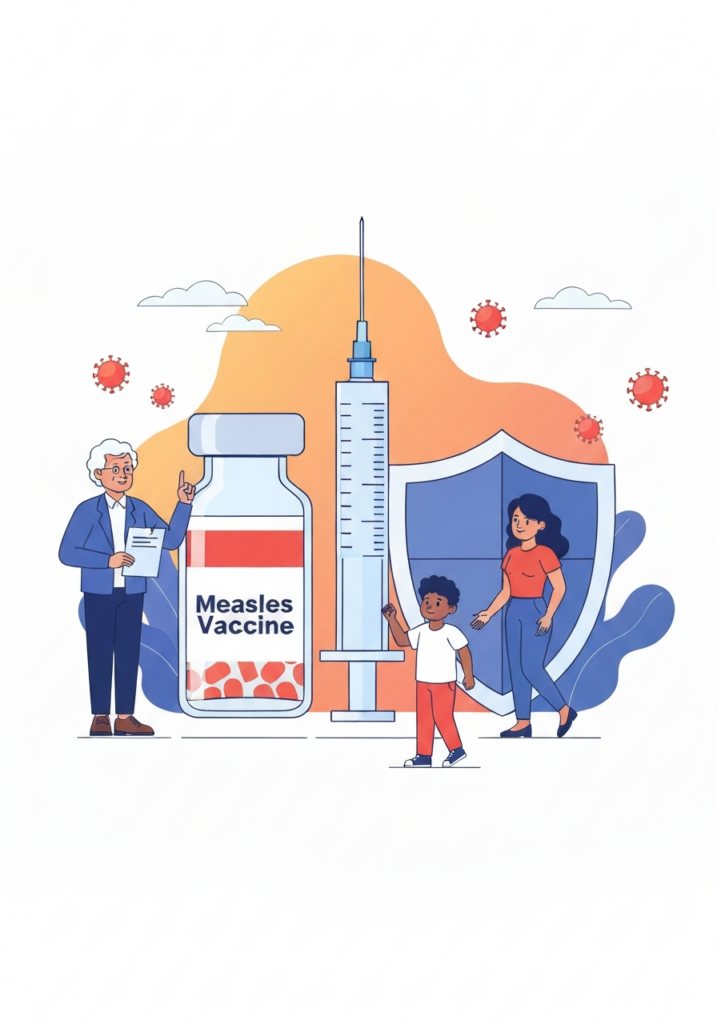
Understanding the recommended vaccination schedule for children and adults is crucial for ensuring full protection. Let’s review when children should be vaccinated, what the recommendations are for adults, and how many doses are needed for lifelong immunity.
When should children get vaccinated?
For long-lasting protection, the measles vaccination is recommended as part of a child’s routine immunization schedule. The vaccine is typically administered in two doses to ensure the highest level of immunity.
The Centers for Disease Control and Prevention (CDC) recommends a specific timeline for these doses. The first dose is given to toddlers, and the second is administered before they start school, providing a booster effect. Keeping up with this schedule is the best way to safeguard your child.
The recommended schedule for the measles vaccine is as follows:
- First Dose: Given between 12 and 15 months of age.
- Second Dose: Given between 4 and 6 years of age.
- Early Dose: Infants traveling internationally may get a dose as early as 6 months of age, but they will still need the two standard doses later.
Adult vaccination recommendations
It’s not just children who need to think about measles vaccination. Many adults may need the vaccine if they don’t have evidence of immunity. If you were born in 1957 or later and have never had measles or the vaccine, you should consider getting vaccinated.
Adults who are unsure of their vaccination status should talk to their healthcare provider. If you can’t find your vaccination records, it is safe to get the MMR vaccine. There is no harm in receiving another dose if you were already vaccinated. This is especially important for adults in high-risk settings like healthcare facilities, colleges, or those planning international travel.
The Department of Health recommends that most adults in this category receive at least one dose of the MMR vaccine. Some, like healthcare workers, may need two doses of the vaccine, spaced at least 28 days apart.
Number of doses needed for protection
To achieve the highest level of protection against measles, two doses of the vaccine are necessary. A single dose provides good immunity, but it’s not enough for complete, long-term protection.
The first dose of the MMR vaccine primes your immune system to recognize the measles virus. The second dose acts as a booster, ensuring that nearly everyone who receives it develops a strong and lasting immune response. This two-dose approach is the standard for preventing measles effectively.
For children, the schedule is one dose at 12-15 months and a second at 4-6 years. Adults who need the vaccine and have not been previously vaccinated should also get two doses of the vaccine, separated by at least 28 days, to be considered fully protected.
MMR Vaccine Effectiveness and Safety
The MMR vaccine is one of the most successful tools in public health for disease control. It is both highly effective at preventing measles and has an excellent safety record, backed by decades of research and use.
Despite its proven benefits, some vaccine myths and concerns still circulate. It’s important to understand the facts about the vaccine’s effectiveness, its potential side effects, and why common myths have been repeatedly disproven. Let’s look at the data.
How effective is the MMR vaccine?
The MMR vaccine is extremely effective at preventing measles. The vaccine works by introducing a weakened form of the measles virus to your body, allowing your immune system to build protective antibodies without causing the disease.
The vaccine effectiveness increases significantly with the second dose. A single dose is highly effective, but adding the second dose ensures that almost everyone is protected for life. This high level of protection is crucial for preventing outbreaks and maintaining “herd immunity,” which protects those who cannot be vaccinated.
Here is a breakdown of the vaccine’s effectiveness after one and two doses of the measles vaccine:
| Number of Doses | Vaccine Effectiveness |
|---|---|
| One Dose | About 93% effective at preventing measles. |
| Two Doses | About 97% effective at preventing measles. |
Side effects and risks of the measles vaccine
Like any medicine, the measles vaccine can have side effects, but they are typically mild and temporary. The vast majority of people who get the vaccine experience no issues at all. The benefits of preventing a serious disease like measles far outweigh the risks of these minor side effects.
The most common reactions are related to the body’s immune response kicking in. These can include soreness or redness at the injection site, a low-grade fever, or a mild rash that is not contagious. More serious reactions are very rare.
Some possible side effects include:
- Soreness, redness, or swelling where the shot was given.
- Fever.
- A mild rash.
- Temporary pain and stiffness in the joints. Febrile seizures can occur, but they are rare (about 1 in 3,000 to 4,000 doses) and are almost always harmless. This risk is lower than the risk of seizures from a measles infection itself.
Addressing vaccine myths and concerns
Over the years, various vaccine myths have caused confusion and concern about the MMR vaccine. One of the most persistent myths is the claim that the vaccine causes autism. This idea originated from a fraudulent and discredited study published in the 1990s.
Numerous large-scale scientific studies conducted around the world have since disproven any link between the MMR vaccine and autism. Major health organizations, including the Department of Health and the World Health Organization, have definitively stated that vaccines do not cause autism.
Addressing these myths with factual information is key. The measles vaccine is one of the safest and most effective medical interventions ever developed. Choosing to vaccinate not only protects you or your child but also contributes to community immunity, protecting vulnerable individuals who cannot get the vaccine.
Conclusion
In summary, understanding measles symptoms and the necessity of vaccination is crucial for protecting not only your health but also the health of those around you. Measles may seem like a distant issue, yet it remains a serious concern, particularly for unvaccinated individuals. By recognizing the early signs and being aware of potential complications, you can take proactive steps to safeguard yourself and others. The MMR vaccine stands as a vital tool in preventing this infectious disease, ensuring that communities remain healthy. Don’t wait for an outbreak to learn more about measles; take the necessary precautions today. For personalized guidance on vaccination and health safety, feel free to reach out for a consultation!
Frequently Asked Questions
What should I do if I think I was exposed to measles?
If you believe you were exposed to an infected person and are not immune, contact a healthcare provider immediately. Getting the measles vaccine within 72 hours of exposure can help prevent a measles infection. Don’t wait for a rash to appear, as early action is key.
Can you still get measles symptoms if vaccinated?
It is very rare to get measles if you’ve had two doses of the MMR vaccine. In the unlikely event a vaccinated person gets sick, the measles symptoms are usually much milder, with a lower fever and less severe rash, because their immune system has a head start in fighting the virus.
Do adults need to get the measles vaccine again?
Most adults born before 1957 are considered immune. If you were born in 1957 or later and are unsure of your vaccination status, talk to your doctor. You may need at least one dose of the measles vaccine for adult vaccination, which is crucial for personal and community disease control.
https://web.archive.org/web/20170908140851/https://books.google.com/books
https://www.ncbi.nlm.nih.gov/pmc/articles/PMC6613570
https://www.cdc.gov/measles/about/complications.html
https://www.who.int/immunization/newsroom/measles-data-2019/en
https://hdl.handle.net/10447%2F513505
https://order.store.mayoclinic.com/flex/mmv/incon01
https://www.dukemychart.org/home/Authentication/Login